Text: Robert Caspersen
Published: Feb 4, 2026
It’s not only the isolation that makes Antarctica feel like the end of the world – like the last stop before the moon. The logistics and price of getting there also resembles a space odyssey. Therefore, it felt like at great privilege once again to set foot on this vast continent in November 2006.
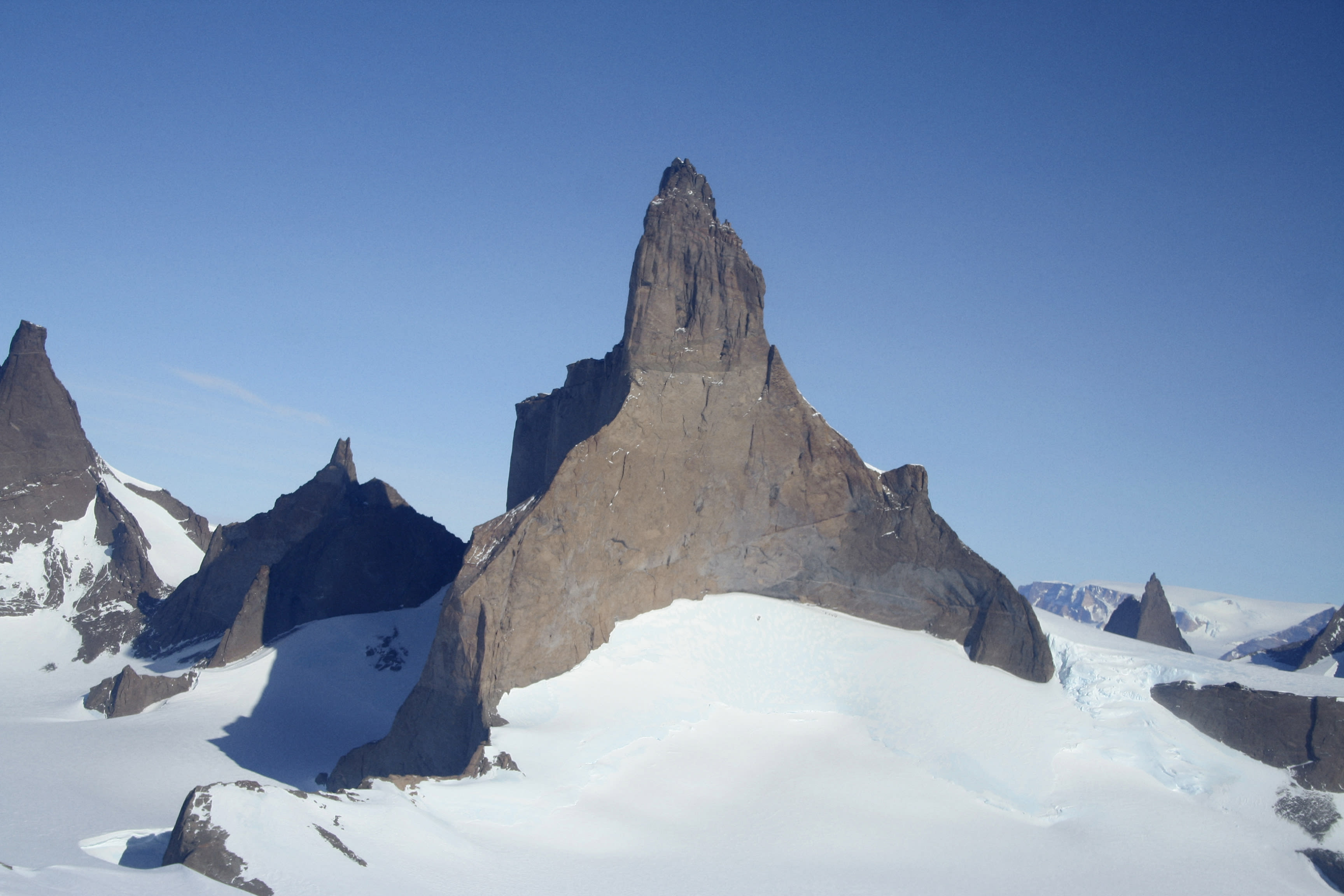
Our main objective was Ulvetanna (2960 m), a majestic peak situated in the Fenriskjeften mountain range in Queen Maud Land. The peak was first climbed in February 1994, by Ivar Tollefsen, Sjur Nesheim and myself, via the west face. On the same trip Trond Hilde and Thomas Cosgriff made an unsuccessful attempt on the north face. Now, Ivar, Trond and I were back, together with Stein-Ivar Gravdal, to try to set the record straight. We had been dreaming about the unclimbed walls of Ulvetanna for almost 13 years.
While the west face, which we climbed in 1994, consists of 500 meters of low angled slabs followed by steeper wall climbing for the last 450 meters, the north face is vertical or overhanging in most of its 1000 meters. Still, the steepest and highest face on the mountain is the east face, with an impressive 1,200 meters drop. Paired with low exposure to the sun in its warming hours and plenty of exposure to the prevailing catabatic winds, this wall seemed like the biggest challenge to us. Therefore, it was our primary goal.
But our expectations were moderate. Trond and I had already scouted the east face back in 1994, and without finding any continuous features we had deemed it impossible. But years of repression and vivid dream activity had convinced me that there had to be a line up this impressive rockface.
Now, finally back after all these years, we approached the wall with awe, our eyes frantically scanning the wall for features. As we got closer it became more and more clear that my fantasy line would never materialise. Half a kilometer from the base of the wall we stopped pulling the heavy sledges with climbing gear and continued with only a pair of binoculars.
Proximity only confirmed our worst suspicions. The features we had discovered in our old photographs turned out to be only geological intrusions, dark or light- coloured veins of different type rock cramped in to the compact rockface. The first climbable features were 600 meters off the ground! Reality was hard but stunningly beautiful.
We quickly recovered from the disappointment, finding comfort in the fact that a central line on the featureless east face probably never will be climbed, at least not in a sensible style. And most importantly, we had a wonderful plan B: The still unclimbed north face.
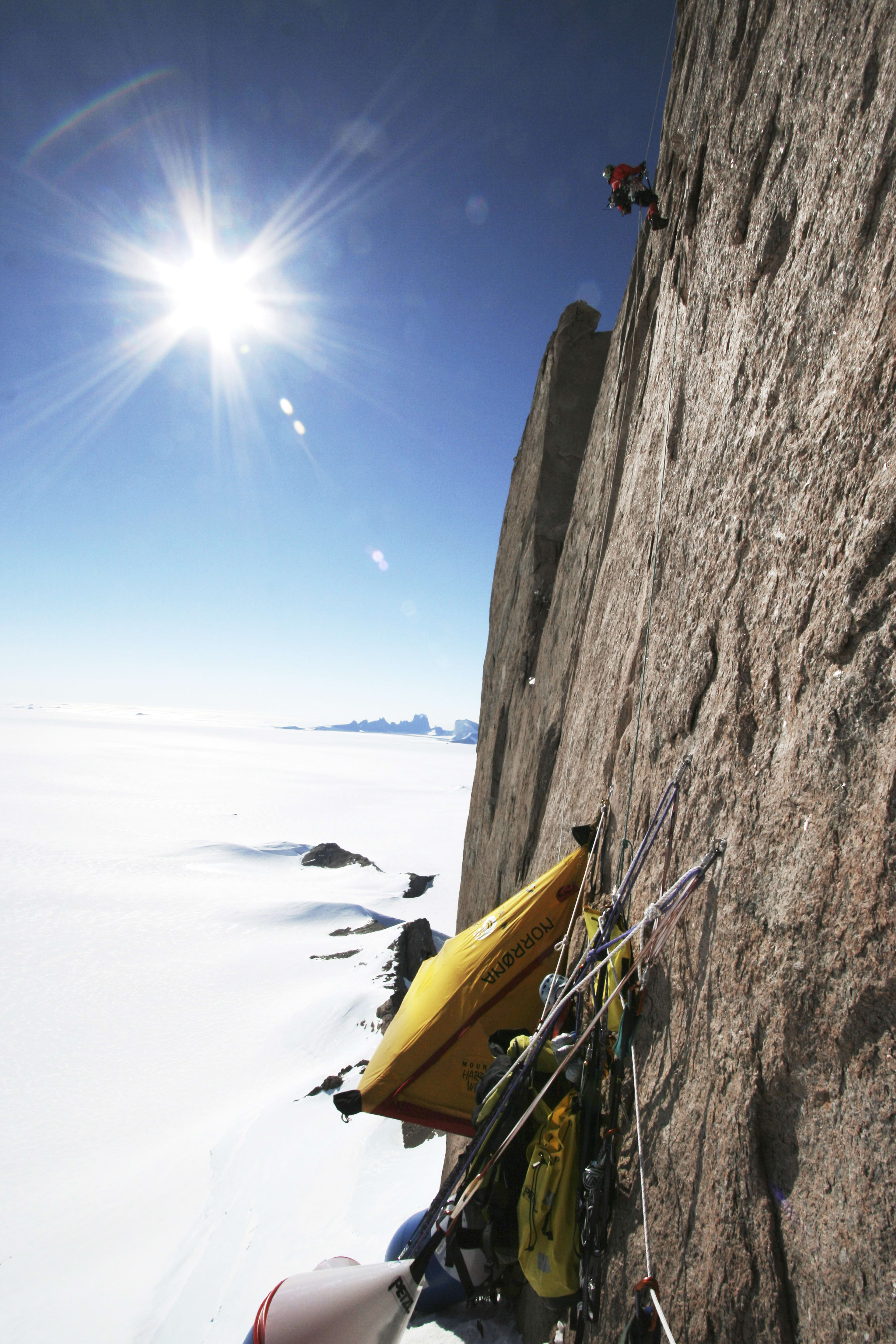
Full of hopes we started moving our base camp to the north side of the mountain. We knew that we would meet a great challenge. Back in 1994 Trond and Thomas had only climbed four pitches on the north face before aborting. The climbing had been serious with two of the pitches graded A4. They had clearly attempted the most obvious line on the wall, but the formations were coarse, and the rock seemed poor. It was not tempting to retry their line. But I had a vague memory from 1994 of an alternative, less obvious line, one hundred meters to the left. Hopefully this was not also a creation of my repressions and vivid dreams...
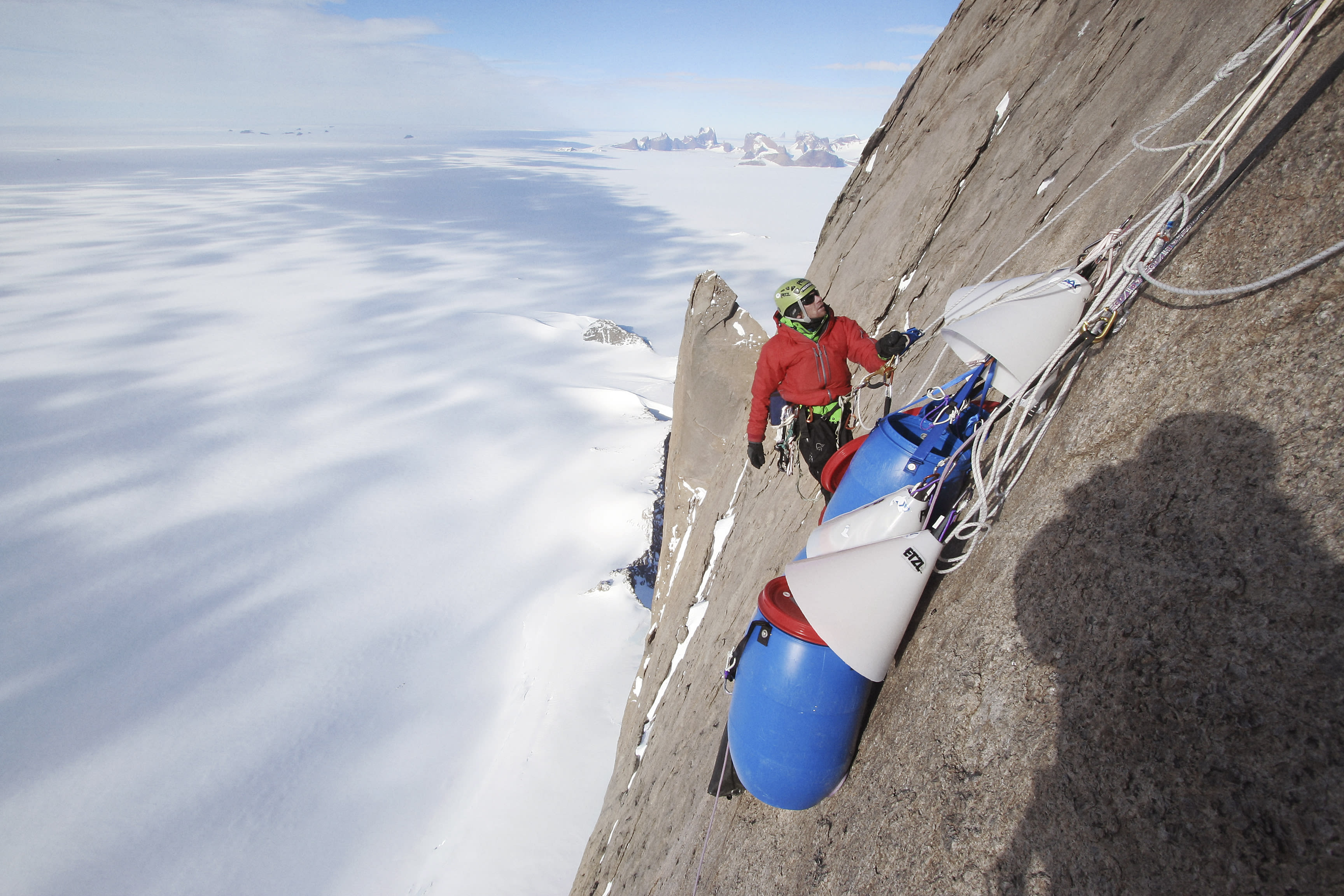
Around the corner of the mountain the north face stood shooting like a rocket, one thousand vertical meters up from the icefield. What a gift! Binocular investigation soon confirmed that there indeed was a thin line of weaknesses left of the centre of the wall. We were in business!
The start of the first pitch set a standard for the things to come: fifteen meters of balancing on skyhooks carefully draped over dubious crystals to reach the first crack. Looking down at the lonely, naked rope leading down to Stein-Ivar, my delight had a bitter taste of dread. I noticed that he had moved a few steps to the side and that he wasn’t too focused on holding the rope, but I didn’t blame him. He was surely fed up of being bombarded by small flakes, and the rope wasn’t much help anyway.
The rock quality was just as expected: Heavily frost-wedged with a coarse and flaky structure. Flakes of all sizes clung to the wall by grace, and the cracks consisted of several layers of rock, like a sandwich construction, but without the essential glue to hold it all together and make it comfortable for climbing on. But we hadn’t come because of the rock quality; we knew from earlier experience that it would be mediocre. The beauty of the place and the feeling of adventure overshadowed this, though important, detail. Strangely enough, I was actually starting to appreciate the rocks (lack of) quality. Its character definitely added to the quality of the climb by making the passages both interesting and exciting.
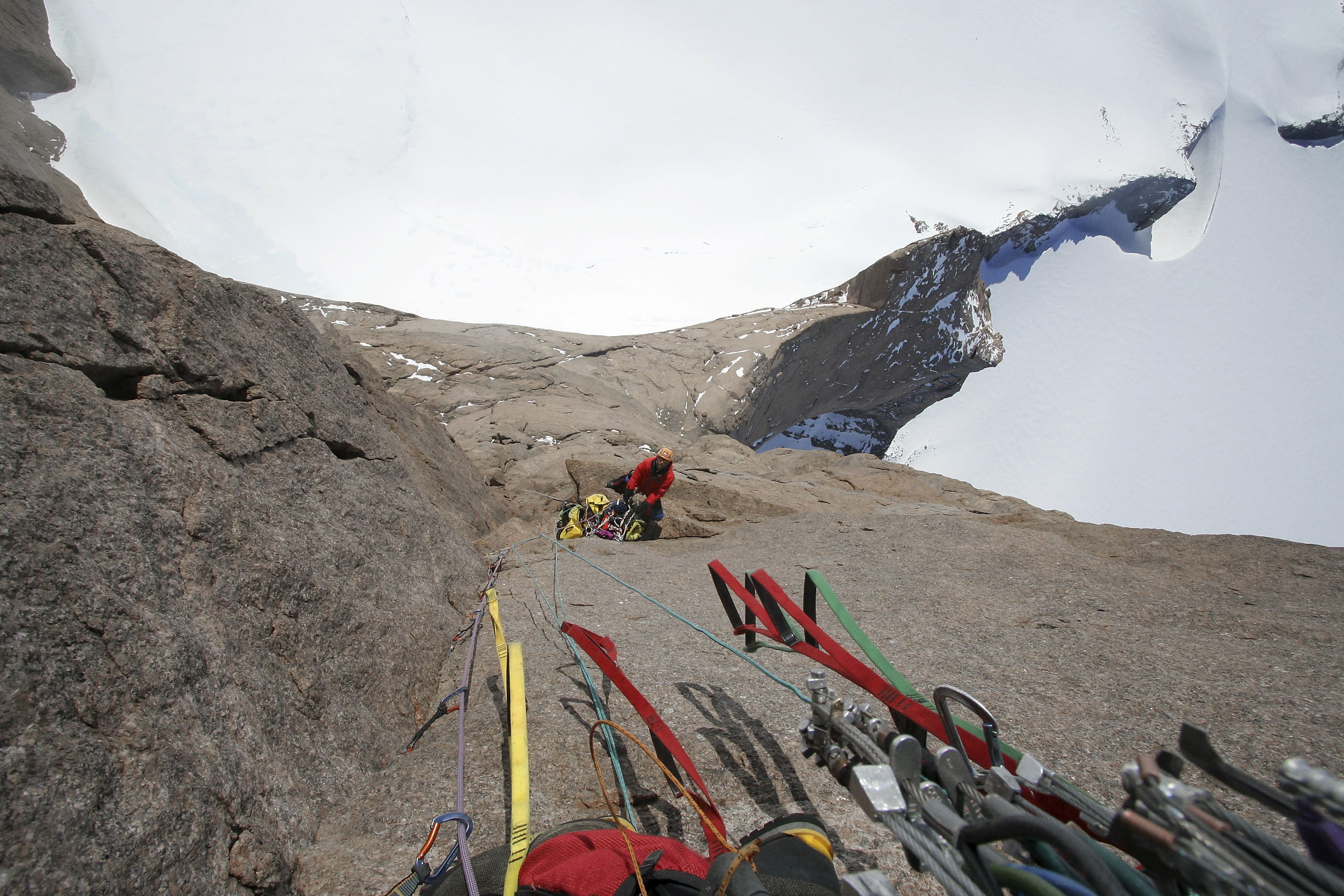
We soon got accustomed to our new A4-lifestyle. Stein-Ivar led the first 15 meters of the second pitch out and over a roof of large singing flakes with an uncomfortable fall potential onto a ledge. The day after I skyhooked eight meters horizontally left, along a relatively solid intrusion of finer grained red granite, perfectly perforated with small concussions for my hooks. Great climbing! The last three skyhook placements were in poorer rock and demanded my full attention. The finish was intense: Hanging from two questionable hooks in opposition, I placed a heel hook up high, reached as far as I could for a sloping side pull, and eased my bodyweight from the etriers carefully over on my heel, taking care not to swing off the holds, pulled up and got a solid knee bar in the next rock formation; safe. I was singing inside – the climbing was ecstatic!
The next pitch was severely overhung. It had looked fairly blank from the ground, and we had feared that this section would demand extended use of bathooking and bolts for progression, tactics we hoped to manage without or at least keep to a minimum. Now a series of small natural formations in the rock emerged and made it possible to progress in fairly good style. After 15 exciting meters the sun disappeared from the wall and the temperature dropped. It didn’t take long before Ivar started moaning at the belay, signalling time to abseil back to our camp on the ground. With temperatures around minus 20-25°C, we preferred to climb, not to mention belay, in the sun. The next day Stein-Ivar finished the pitch in an impressive style. Despite the long fall potential he refrained from drilling more than two bolts and ten bathooks in 40 meters. Jumaring past in mid air the day after, I studied the pitch with awe.
A long pitch with thin loose flakes followed. Here, a seemingly solid hook placement exploded and sent me flying for the first time. The fact that the edge had held me for five minutes before it decided to crumble didn’t encourage further trust. Luckily it was steep so I didn’t hurt myself. At the top of the fourth pitch I found a ledge with enough snow to cover many days of water supply, so now there was no longer any excuse not to move up on the wall and commit ourselves to the climb.
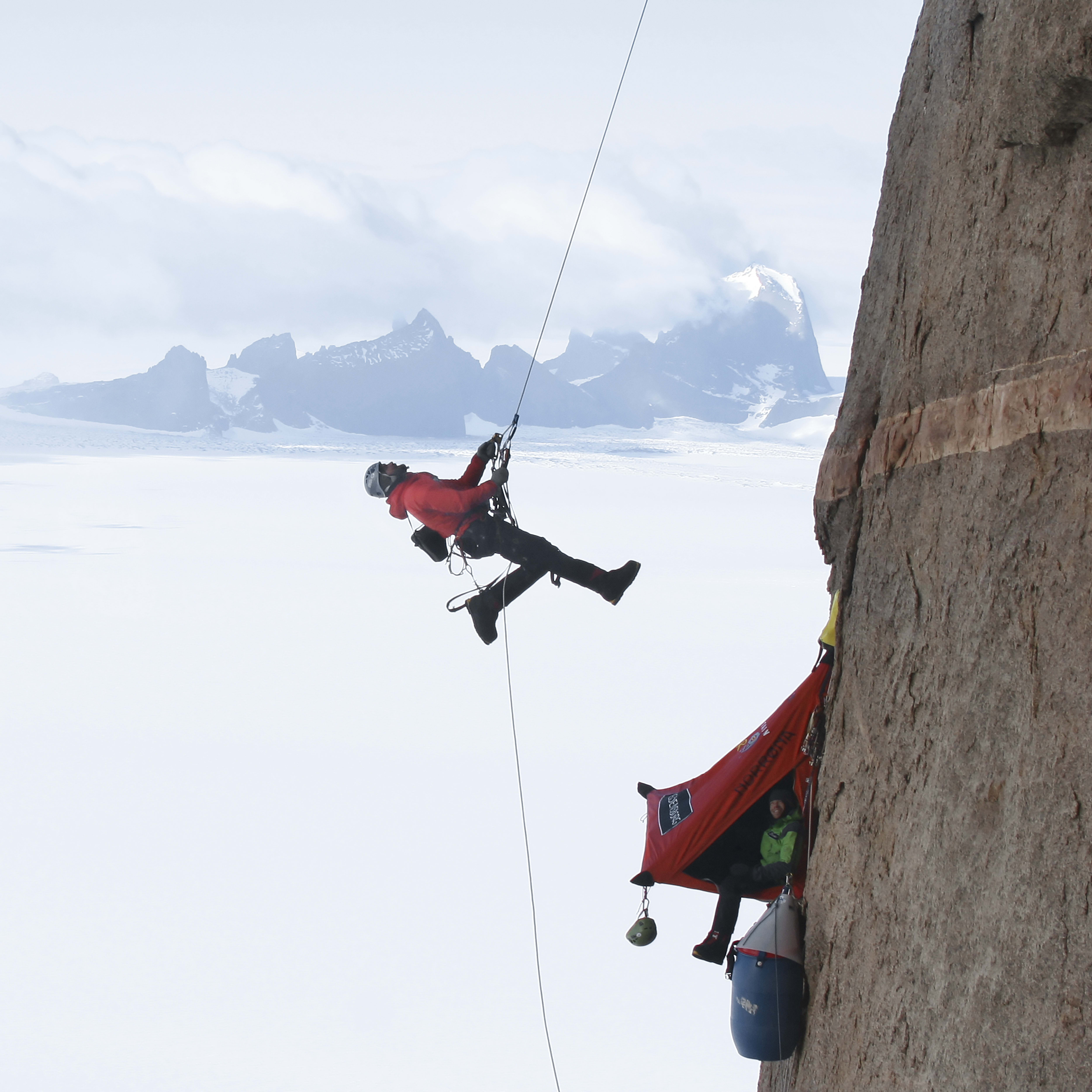
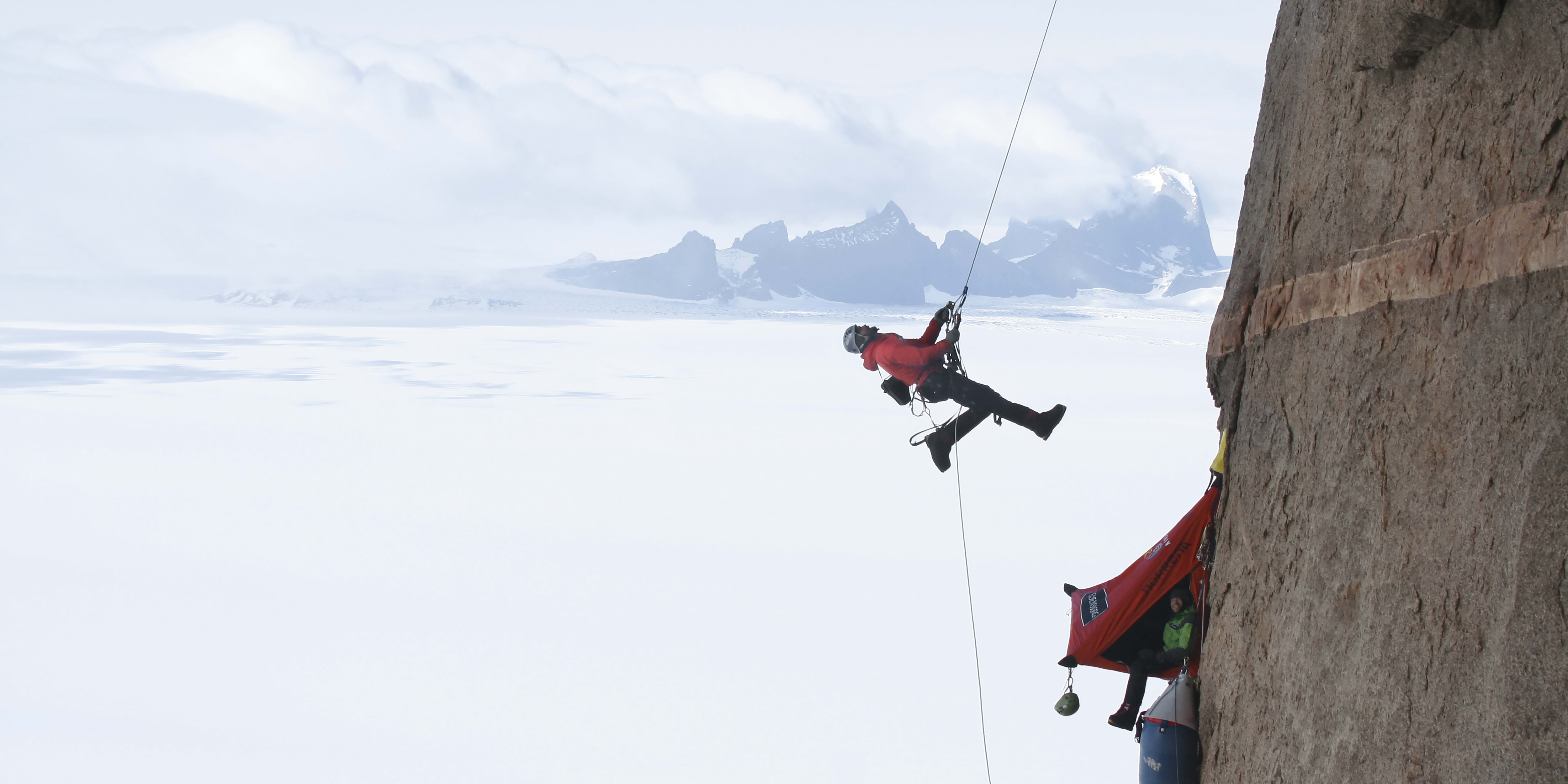
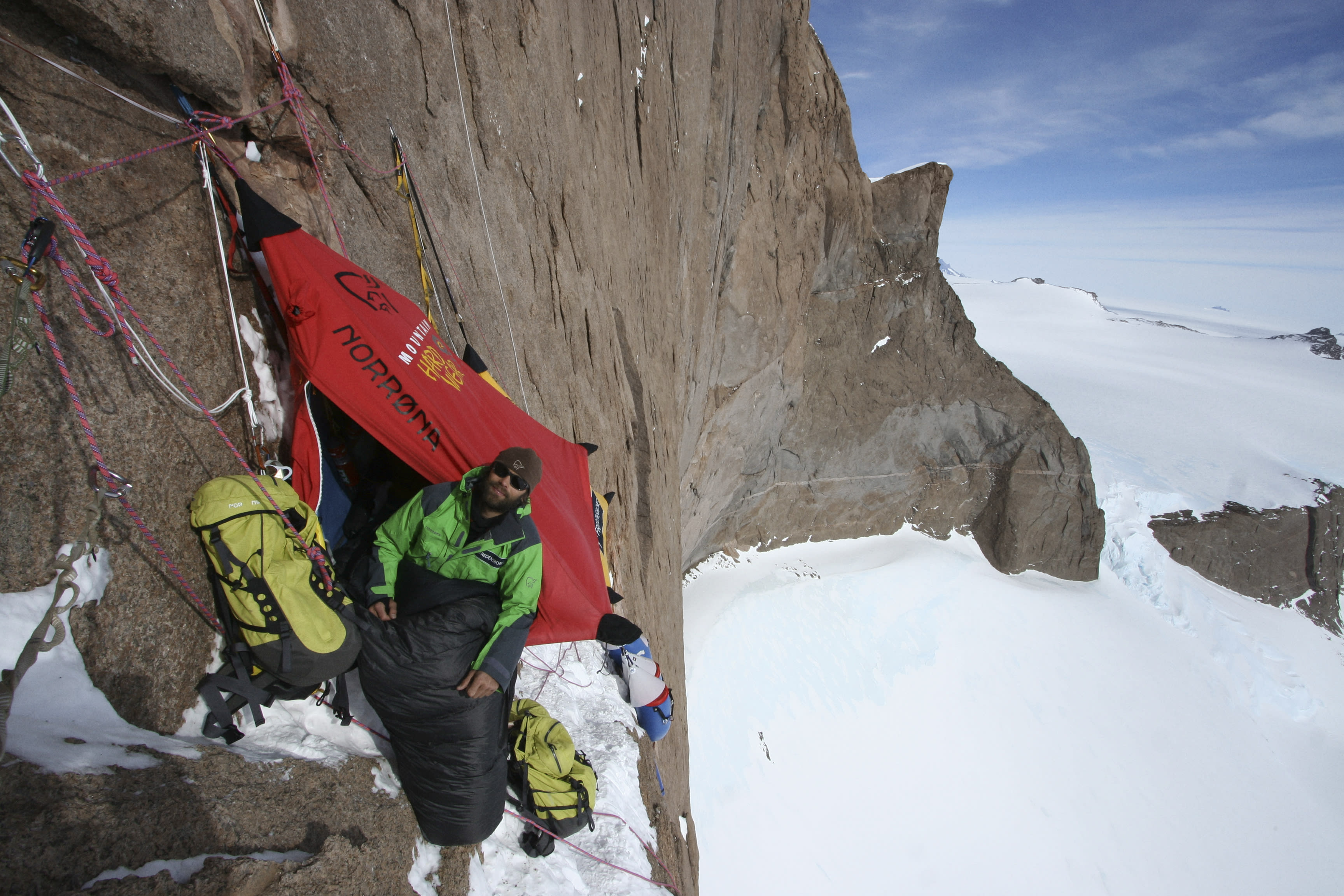
The light was blue and the shadows on the ice plateau long when we finally crawled into our wobbly nylon nest. I had forgotten how cramped a port-a-ledge becomes when two adults in full winter armour enter ... It is quite an operation to undress the big clothes and boots, get the stove going with only a few centimeters of clearance to highly flammable polyester and nylon on all sides, and then balance the pot with three litres of boiling water while cramps torment your compressed body. But what a safe haven! – A pause from the vertical world outside. Then the luxurious three dishes every night. First soup, preferably a fish soup, followed by a freeze dried surprise, usually tasting similar to chicken and rice, and then chocolate, both in solid and a liquid form. Full up, safe and happy. Good night.
The mornings were as always both mentally and physically the most demanding part of the journey. From deep inside the warm comfort and safety of the sleeping bag, peeping through a hole at the inside of the tent covered with an inch of ice, knowing that once you start moving it will start to find its way into your neck and make your clothes wet and cold, warm and safe in your sleeping bag thinking about the world outside the tent: consequences of ambitious moments, exposure and uncertainty ... Out and up!
-Enhanced-SR.jpg)
Above camp 1 the wall was less steep, with more and bigger formations. For a short while the climbing was faster, but soon enough the formations disappeared and a new wonderful A4 pitch revealed itself. Again I followed a beautiful intrusion of finer grained red granite, this time 30 meters diagonally upwards. The whole day was spent searching for gear placements to support my body weight where there seemingly was none. I was close to giving up several times, but one more unreal placement after the other gave me enough support to continue. I found good use of the short knifeblades, birdbeaks and copperheads, and sometimes only by equalizing two or three such points did I find enough support to progress.
It was a wonderful, intense day. 20 meters above the last good piece I finally reached a decent crack that led me to a narrow sloping ledge. I was somewhat disappointed by the amount of snow on the ledge since it would have to serve as our next camp. If the climbing above became slow we would probably not have enough snow for food and drink.
When we moved camp the next day this issue was buried by a two day snowstorm. The spindrift from above was constant and resembling small avalanches. Ivar and I struggled to pitch the tents in the snow chaos, but I had to smile. It was nice feeling the elements. We had extra energy and enough control of the situation to experience the seemingly dramatic situation and our exposed position as something positive. It was fun with a brake from the blue sky and now at least we didn’t have to worry about not finding enough snow for water and food. This probably also meant great skiing conditions later when we returned to the ground!
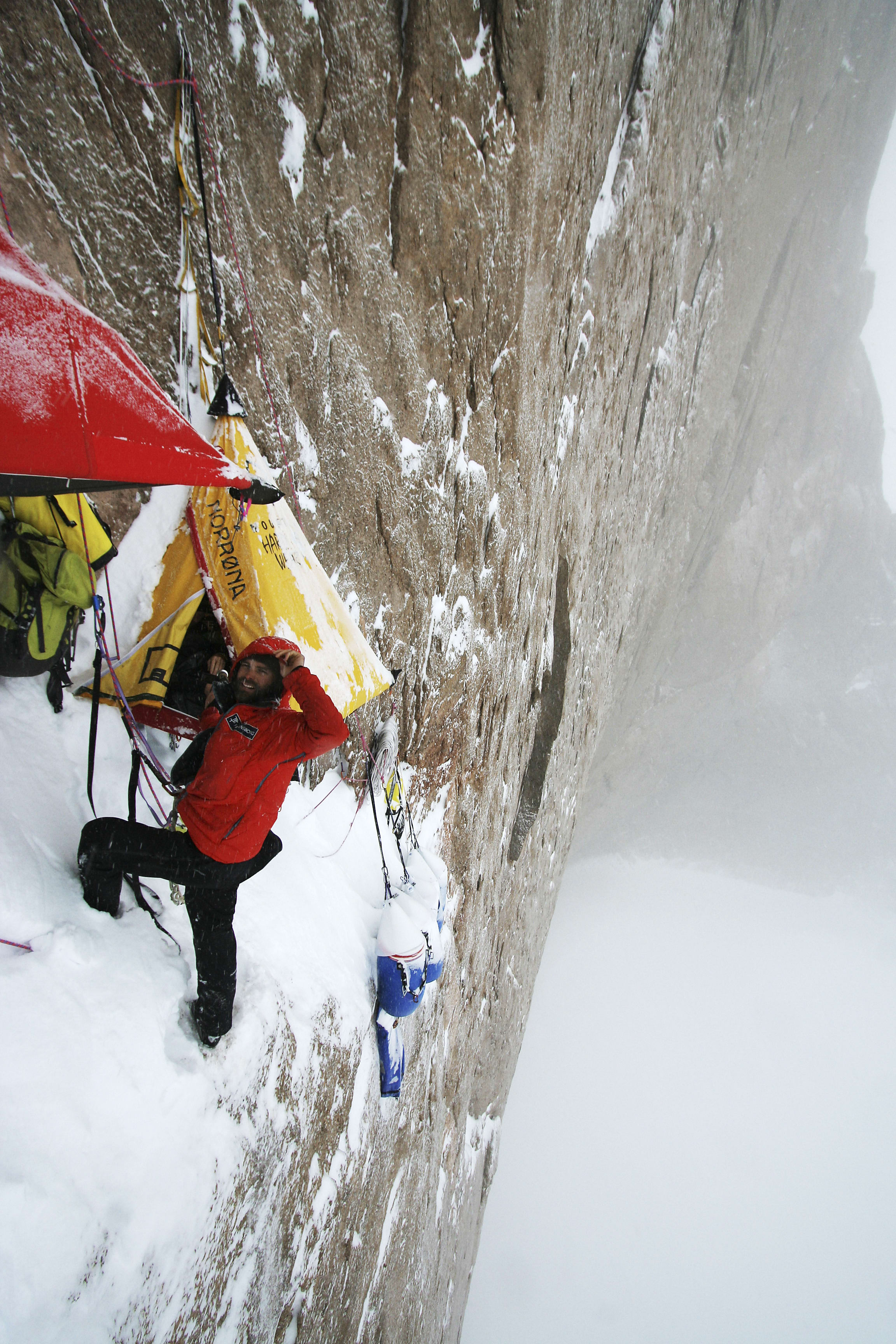
Luckily not everybody had been loyal to the packing list, soon two complete novels appeared and were dissected into a pass-around-library for everyone.
I thought about how smoothly everything had gone up to now. Despite our personal differences, the four of us worked really well together as a team. We seemed to share a common understanding of what it takes for a group of people to achieve a goal together – at least such an easy and well-defined goal as a mountain summit.
We were all pulling in the same direction. We all felt very privileged to be here, and the surroundings put us in a state of awe. This state of mind coloured our words, deeds, and our interplay, and helped make the atmosphere good and relaxed. This was our dream holiday.
After 48 hours cramped in the port-a-ledges, it felt like a relief when the storm finally lifted, and we could stretch our limbs properly again. Stein-Ivar and I continued to lead every other day, while Trond and Ivar swapped freezing at the belay. After first an easy pitch, two slightly harder ones and two easier ones, we reached a fantastic bivouac ledge under some giant roofs, two thirds up the wall. The 50m2 Alcove made a perfect base for the last leg up the top pyramid.
From the Alcove we had to traverse left for 25 meters to reach the crack system we hoped would lead us to the summit. I could feel Stein-Ivar’s envious stare as I racked up and set off.
The pitch had amazing exposure, and I climbed with a big smile on my face the whole day. The quality of the climb astonished me. On our other climbs here we had often ended up climbing fairly big formations – grim squeeze chimneys and off widths – which of course was quite normal since we were trying to do first ascents of summits via the easiest way. But on this wall we were climbing the one thin and exposed pitch after the other, and the rock quality was by far the best we had experienced in Queen Maud Land.
Stein-Ivar and Trond got their own dream pitches the next day, following a perfect crack in the depths of a huge and severely overhung dihedral – exquisite. Their long day and three pitches brought us in position for a summit bid. And the next day, after two moderate and two easy pitches, we were just below the summit. I stopped, startled, as I discovered an old sling around a piece of rock in front of me. What, traces of others ... ?
Then memories flooded me. It had gone 13 years since I had placed that sling and abseiled down the west face after reaching the summit with Ivar and Sjur. At that time I did not imagine the possibility of ever visiting this continent again, I felt too privileged to dear to. Now my intense feeling of privilege had a new dimension: With a wife and two children at home, I was enjoying the best of two worlds – I felt like the luckiest man on earth.
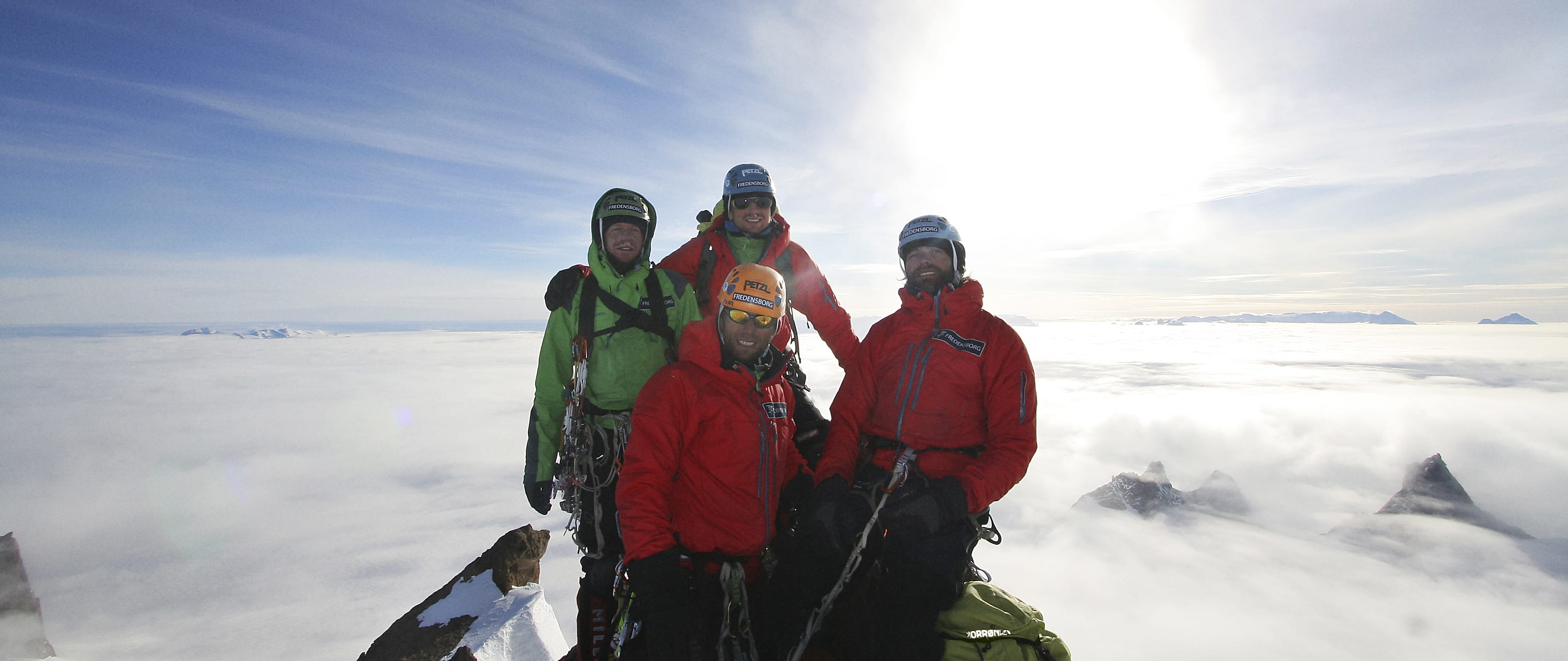
Soon the others followed and in the evening the 20th of November 2006, 16 days after leaving the ground, we stood together on the summit in silent awe. The weather was amazingly calm, with no wind. The landscape to the south and west which had been obscured to us while on the north face, now lay before us in all its splendour.
At our feet, the ragged teeth of Fenriskjeften, the perfect profile of Holtanna, the huge Kinntanna with a myriad of complex arêtes, the fortress of Midgard – a piece de resistance – and all the other sculptured summits. Further away, Gessnertind, Rakekniven and the Troll Castle, and in the far distance the Fimbulheimen with King Olavs Mountain. A fantasy world of virgin summits, walls and ridges, perfectly placed on an endless plateau of ice, so simple, so clean.
To make sure we stayed humble and respectful, nature choreographed our summit goodbye in an unforgettable way. As we stood there absorbing the good feeling of dreams fulfilled and new horizons experienced, clouds appeared out of nowhere and silently started to cover everything. Before long the whole world had disappeared under a thick white carpet, just leaving the summit of Ulvetanna clear above.
We knew our visiting time was over. On the ground new adventures awaited us. Luckily, we still had three weeks left of our holiday.